Just Launched: The SourceCo Marketplace. Access vetted, off-market founder-led deals before anyone else.
Last deal added: 12 hours ago · Avg deal size: $8.2M · Median revenue: $4.9M
See Live Deals →

%20(1).png)
Median time from outreach to close: 6 to 12 months
Start a confidential exploratory conversation
Enter your site. We'll show you real buyers acquiring in your space. No signup. Confidential.
Show Me →
Takes 30 seconds · No cost
Enter your site. We'll show you real buyers acquiring in your space. No signup. Confidential.
Show Me
Takes 30 seconds · No cost
"I don't need anybody knowing what I'm exploring."
That is the frame most mechanic shop sales begin in. Not urgency. Not a decision. An owner who is comfortable and knows that asking the question in the wrong direction ends the option before it starts.
One conversation reaches an employee. A supplier mention travels to a competitor. A buyer without financing wastes sixty days and your financials. An LOI (Letter of Intent) gets signed and the price changes during diligence. Any of these can happen before you decide anything.
You can explore without triggering any of them. Share an anonymous shop summary first: no name, no address, no employee details. Require a signed NDA (Non-Disclosure Agreement) before sharing financials. Stage disclosure so only qualified, serious buyers reach the sensitive details. That discipline, applied from the first conversation, is what keeps the shop stable while you decide.
The answer is staged disclosure: share the minimum at each step to advance the conversation, and never share identifying information or financial details until a buyer has earned access to them.
[[definition-list: Three documents that control what you share and when]]
Teaser | A one to two page anonymous summary of your shop: service mix, revenue range, geography (region, not address), and operating profile. No name. No location. No employees named. Shared with pre-screened buyers to test interest before any NDA is signed.
NDA (Non-Disclosure Agreement) | A contract that legally prevents a buyer from sharing, using, or disclosing the information you provide about your shop. Required before you share any identifying details, financials, or customer information. Non-negotiable.
CIM (Confidential Information Memorandum) | A detailed buyer packet covering your financials, operations, customer mix, staffing, and facilities. Shared only after the NDA is signed and after initial buyer interest is confirmed.
The sequence: teaser first, NDA before identity, CIM only to screened buyers. Buyers who will not sign an NDA before receiving details are not serious buyers.
Confidentiality leaks in mechanic shops almost never come from the formal sale process. They come from the edges. The most common failure points:
[[step-process: 6-step confidential mechanic shop sale process]]
Preparation | Build 3 years of monthly P&Ls, document every add-back (costs that will not continue under new ownership, such as owner salary above market rate or personal vehicle expenses) with receipts, identify your lease assignability status, and map which customer relationships sit with you versus your team. This is done before any buyer conversation.
Anonymous teaser | Prepare a one to two page summary: service mix, revenue range, general geography. No name, no address. Share with a short list of pre-screened buyers whose investment logic fits your shop.
NDA | Require a signed Non-Disclosure Agreement before sharing any identifying information, financial statements, or operational details. No NDA, no details.
CIM and buyer call | Share the full buyer packet after the NDA is signed. Follow with a call or meeting to answer questions. At this stage you are still evaluating the buyer, not committed to any process.
LOI and due diligence | Select a buyer and negotiate a Letter of Intent (LOI) covering price, structure, and key terms. Due diligence follows: the formal verification phase where the buyer confirms your financials, operations, lease, environmental standing, and key personnel.
Close | Sign the purchase agreement, receive payment per the agreed structure, and begin the transition period as defined in the deal.
If you run this six-step process yourself, you are doing the work of an experienced intermediary in a domain where the counterparties negotiate these transactions routinely and you are doing it once in a lifetime. The preparation stage alone requires financial documentation, legal review, and buyer screening without a database of transaction history to draw from.
That information asymmetry affects every document you review, every term you accept, and every add-back you defend. The six steps above are real, and running them without experience, infrastructure, or a buyer network is the problem the next section addresses directly.
[[cta-advisor]]
There are three ways to find buyers for a mechanic shop. They are not equivalent. Understanding what each path actually costs (money, confidentiality, and owner time) is the most important decision in the entire sale process, because the path you choose determines how much of the headline price you keep, whether your employees find out before you decide to sell, and whether the buyer who closes is the right buyer or just the first buyer.
Path 1: Do it yourself
You run the teaser-to-close process independently, reaching out to buyers you identify or know.
The real costs: Running a confidential DIY sale requires approximately 80 to 150 hours of your time over 3 to 6 months, based on SourceCo's analysis of owner-managed sale processes. You build the teaser, identify buyers, screen them without a database of transaction history to draw from, negotiate the NDA, manage document requests while your shop continues to operate, and review LOI terms you may not have seen before. At each stage, the buyer has done this many times. You have done it once, or zero times.
The confidentiality exposure is meaningful. DIY outreach to buyers typically reaches people in your network or your local market: operators, chains, or acquirers who may know your employees, your suppliers, and your competitors. One conversation in the wrong direction ends confidentiality before you have a deal.
Path 2: Traditional broker-led sale
You hire a business broker who markets the shop broadly and represents the transaction.
The real costs: Business broker commissions for small business sales typically run 8 to 12% of the sale price, per IBBA fee norms for owner-operated business transactions, reflected in SourceCo's analysis of outreach path costs. On a $1 million transaction, that is $80,000 to $120,000 that comes off your proceeds before you see them. On the $1,330,000 worked example from the previous section, a 10% broker commission reduces your take-home by $133,000, before any working capital shortfall (a gap between actual current assets and the buyer's required minimum), earnout (proceeds contingent on post-close performance), or escrow (proceeds withheld after close against potential claims).
The confidentiality exposure is structural. A broker-listed business typically appears in listing databases and search results visible to anyone, including employees, suppliers, competitors, and customers. A mechanic shop listed in a regional market is not confidential by default. The broker's incentive is to close the deal, not to find the right buyer. They earn the same fee whether the buyer is the best cultural fit for your team or the first serious offer that meets the price.
What the broker does not know: what you want after the financial package is agreed. They know the financials well. They typically do not know how long you are willing to stay, whether your team's continuity matters, or what kind of buyer will honor the reputation you built with your customers. That information rarely travels from owner to broker to buyer in a way that shapes the deal.
Path 3: SourceCo
Two things: your numbers, and a conversation about what you are looking for.
SourceCo takes those two inputs and matches your shop to buyers in SourceCo's network whose investment thesis, deal structure preferences, and post-close philosophy actually fit what you described. Not volume outreach. Not a listing. Fit-first matching based on real buyer conversations SourceCo has had about culture, transition expectations, and what each buyer is actually building.
The shop is never listed. Buyers are contacted anonymously. Identity is only shared after buyer interest is confirmed and an NDA is in place. You control the information at every stage. There is no commission from the seller. SourceCo works on the buyer side, which means the $80,000 to $120,000 that would have gone to a broker stays in your waterfall entirely.
The honest limitation: SourceCo's network is finite. If no buyer in the current network is the right fit for a specific shop, the timeline may extend while the right match is identified. Fit-first matching takes longer than volume-first matching when fit is narrow. That is the trade-off.
Here is how the three paths compare directly:
| Do it yourself | Traditional broker | SourceCo
Cost to owner | 80-150 hours of your time + legal fees, per SourceCo's analysis of owner-managed processes | 8-12% of sale price (per IBBA broker fee norms); on a $1M deal, $80K-$120K off your proceeds | No cost: SourceCo works on the buyer side
Confidentiality exposure | High: outreach reaches people in your market who know your staff and competitors | High: shop listed in databases visible to employees, competitors, and customers | Controlled: anonymous outreach only, identity never shared without approval and a signed NDA
Buyer quality and fit | Limited to your personal network; no screening infrastructure | Volume-optimized; more buyers means more fee risk; fit is secondary to closing | Pre-screened against your shop profile and stated preferences before any conversation
Cultural fit matching | You describe what you want; buyers hear what they want | Broker knows the numbers; typically does not carry your cultural priorities into buyer conversations | Based on real buyer conversations SourceCo has had about culture, transition philosophy, and post-close expectations
Time from you | 80-150 hours alongside running the shop | 40-80 hours; less than DIY, but not zero | One conversation and your numbers
Commission impact on proceeds | None (but undocumented add-backs and unreviewed LOI terms have real dollar cost) | $80K-$120K on a $1M deal before anything else comes off | None: that money stays in your waterfall entirely
[[cta-match]]
Different buyers price different risks, which means the same shop can produce very different offers on the same day. Each underwrites the business on SDE (Seller's Discretionary Earnings, the total earnings available to an owner-operator) or EBITDA (Earnings Before Interest, Taxes, Depreciation, and Amortization, used for larger or managed shops); the same business can look different through each lens. The headline multiple is not what separates the offers; the terms beneath the headline are.
The following frameworks are based on SourceCo's analysis of buyer conversations across automotive services transactions. Evidence for mechanical-specific buyer behavior is adjacent to collision research; transition expectations and structural preferences reflect patterns SourceCo observes, not published benchmarks.
Factor | PE platform | Independent sponsor | Strategic operator | Search fund
Primary screen | Management depth, scalable operations, clean financials, integration capacity | Strong fundamentals, owner-dependent OK with transition plan, operational upside potential | Location quality, technician and customer relationship fit, local market presence | Ability to step into operating role, real earnings, low key-person risk beyond the owner
What they underwrite | Repeatable EBITDA/SDE at scale, buyer team's ability to operate post-owner | Current earnings quality, path to reducing owner dependence, growth potential | Synergy with existing operations, customer overlap, staff retention | Management takeover feasibility, clean earnings, defined transition period
Transition expectations | 3 to 12 months, defined role, often operational overlap | 6 to 24 months, operator plans to take over the role | 3 to 6 months, often integrating into existing operations | 6 to 24 months, search fund operator taking over actively
What they may ask for | Earnout tied to revenue or technician retention; heavier post-close reporting | Seller note (a loan from you to the buyer, repaid with interest) on part of the price; earnout if earnings are borderline | Seller note common; simpler structure overall | Earnout or seller note; may request longer transition
Legacy and staff | Business may be rebranded depending on platform strategy; staff usually retained | Staff usually retained; culture depends on the operator | Culture varies; staff retention common | Operator typically maintains existing staff and identity
To make the difference concrete: a shop generating $400,000 in normalized SDE receives three conversations on the same week.
A PE platform building regional density offers 3.5 times SDE ($1,400,000 enterprise value, the headline business price before debt and working capital adjustments) with a 12-month earnout covering 20% of the price, tied to technician retention. They need 60 days of exclusivity (a period during which you agree not to negotiate with other buyers) for diligence.
A local strategic operator running two shops nearby offers 3 times ($1,200,000) with no earnout, a 90-day transition, and a seller note (a loan from you to the buyer, repaid over time) covering $200,000 of the price. Simpler, less upside, faster close.
A search fund operator offers 3.75 times ($1,500,000) with a $300,000 seller note repaid over 4 years at 6% interest. They want 18 months of transition with the owner actively present. Cash at close is lower because of the seller note, but the total structure adds up to more if the earnout or note payments come in full.
Same $400,000 SDE. Three deals. The at-close cash ranges from approximately $1,000,000 to $1,200,000 depending on structure, with the PE offer landing at roughly $1,120,000 once the earnout is stripped out. The total over time ranges from $1,200,000 to $1,500,000. The right choice depends on the owner's transition preferences and tolerance for earnout or seller note risk.
"Walk away. Walk away."
One shop owner with a fully staffed, fully managed operation said those two words when asked what a transaction should look like. The structure that serves that preference is the clean exit with a short defined transition. The structure that works against it is the earnout tied to post-close revenue where the owner must remain engaged to protect the payout.
[[cta-match]]
The headline price is the start of the math, not the end of it.
[[definition-list: How buyers measure what your shop earns]]
SDE (Seller's Discretionary Earnings) | Your shop's earnings before the owner's salary, personal expenses, and non-recurring items. Used for smaller owner-operated shops, typically under $5 million in revenue. Reflects the total cash benefit available to a new owner-operator.
EBITDA | Earnings Before Interest, Taxes, Depreciation, and Amortization. Removes financing and accounting decisions that vary by ownership. Used for larger or professionally managed shops where a new owner would hire a general manager at market rate.
Add-backs | Costs on your tax return that a buyer agrees will not continue under new ownership. Examples: owner salary above a market-rate manager, personal vehicle expenses, one-time legal fees, family payroll not needed after close. Each add-back requires documentation.
Normalized earnings | Your SDE or EBITDA after removing one-time items and adjusting for costs that reflect your specific ownership rather than the business itself. This is the number buyers actually underwrite.
Enterprise value (EV) | The total price a buyer pays for the business, before debt, cash, and deal adjustments. Enterprise value = normalized earnings multiplied by the agreed multiple.
Equity proceeds | What you actually receive after subtracting debt, working capital adjustments, transaction costs, and any earnout or escrow holdbacks from enterprise value.
WIP (Work in Process) | Billable jobs started but not yet invoiced: labor and parts on vehicles in the bay. WIP is counted as a current asset in the working capital calculation, but only if it is tracked and documented. Untracked WIP understates your working capital balance and can widen the closing adjustment gap.
Working capital peg | The amount of current assets (including cash, receivables, and WIP) minus current liabilities the buyer requires in the business at close. If your actual balance is lower than the target, the shortfall reduces your proceeds directly.
Buyers evaluating mechanic shops apply operational screens before looking at normalized earnings. SourceCo's analysis of buyer conversations identifies four mechanical-specific signals buyers consistently examine: average repair order (ARO), the average revenue per vehicle, which signals whether the shop captures complex work or mostly minor services; effective labor rate, the actual dollars billed per labor hour compared to posted rates, which shows pricing discipline and technician productivity; bay utilization, how many bays are producing revenue versus sitting idle; and car count stability over the trailing 24 months.
When these metrics are weak (a declining car count, low ARO from mostly minor services, or underutilized bays) buyers either discount the multiple, add earnout conditions tied to performance recovery, or build larger due diligence reserves into their offer. Strong, documented metrics support a higher multiple within the shop's size band.
Here is how a real P&L converts to a buyer's working number:
Step | Item | Amount
Starting point | Reported net income (tax return) | $280,000
Add back | Owner salary above market GM rate ($95K salary, $65K market rate) | +$30,000
Add back | Personal vehicle and phone expenses | +$14,000
Add back | One-time equipment purchase (not recurring) | +$18,000
Add back | Depreciation and amortization | +$32,000
Add back | Interest expense | +$6,000
Owner's normalized SDE | | $380,000
Buyer challenge | Questions whether the one-time equipment cost truly was one-time (recurred in 2 of 3 years reviewed) | -$18,000
Buyer's working normalized SDE | | $362,000
That $82,000 spread between the tax return figure and the buyer's working SDE is not a negotiation about value. It is a documentation problem. The $18,000 equipment add-back was real; it was just not supported clearly enough to survive a quality of earnings review.
At 3.5 times on $380,000 normalized SDE, enterprise value is $1,330,000. At 3.5 times on $362,000 (after the challenged add-back), enterprise value drops to $1,267,000. A documentation gap costs $63,000 in headline value before any other adjustment.
Here is what that $1,330,000 enterprise value becomes by the time it lands in your account:
Step | What it means
Enterprise Value | $1,330,000 (normalized SDE of $380,000 at 3.5x)
Minus: Net debt | Equipment loans and line of credit: -$85,000
Minus: Working capital shortfall | WC target was $65,000, actual was $42,000: -$23,000
Minus: Transaction costs | Legal, tax advisory, intermediary: -$55,000
Subtotal before earnout | $1,167,000
Minus: Earnout (15% of price, 12-month retention target) | -$199,500
Cash at close | $967,500
That is $362,500 between the headline number and the first check. The earnout may be earned in full over 12 months, bringing total proceeds to $1,167,000. But $199,500 arrives only if the technician retention and revenue targets in the LOI are met post-close.
The working capital adjustment surprises owners almost every time. The target was in the LOI. In SourceCo's experience with owners, attention is on the multiple at signing. The working capital target in the LOI rarely gets the same focus until the closing statement arrives.
[[cta]]
Signing the LOI is not closing. Between the LOI and close sits a 60 to 90 day due diligence period (the formal verification phase where the buyer confirms your financials, operations, and legal standing) during which the buyer verifies everything the price was based on. Deals fall apart in this window, and almost always for predictable reasons.
Documents buyers will request for a mechanic shop:
Financial records
Operational records
Lease and real estate
Environmental
Legal and structure
[[definition-list: Deal structure terms that affect what you receive]]
Asset sale | The buyer purchases specific assets of the business: equipment, goodwill, customer relationships, trade name. Most mechanic shop transactions are structured as asset sales (approximately 70-80% of lower-middle-market deals, per Stout Advisors' automotive repair due diligence framework). The seller retains the legal entity. The buyer gets a stepped-up tax basis on acquired assets.
Stock sale | The buyer purchases ownership in the legal entity itself, inheriting all assets and liabilities including historical ones. Sellers typically prefer stock sales (capital gains treatment). Buyers typically resist them in mechanical repair because of environmental liability exposure.
Exclusivity | The seller agrees not to negotiate with other buyers for a defined period after signing the LOI, typically 45 to 90 days. This is what makes a retrade so costly: you give up other options during exclusivity while the buyer renegotiates from a position of information advantage.
Retrade | When a buyer reduces the agreed price after signing the LOI, citing issues found in diligence. Often presented as a quality of earnings adjustment. The owner has already disclosed sensitive business details before the retrade occurs.
Earnout | Proceeds contingent on post-close performance, paid over 12 to 36 months if defined targets are met. Common when technician retention risk, owner dependence, or fleet account concentration exists.
Seller note | You lend part of the purchase price to the buyer at a negotiated interest rate, repaid over 3 to 7 years. Common in SBA-financed transactions and when buyers need to bridge a gap between financing capacity and agreed price.
Escrow or holdback | A portion of proceeds withheld after close to cover potential indemnification claims. Typically 5 to 10% of the purchase price, released after 12 to 18 months if no claims arise.
Non-compete (seller) | An agreement where you, as the seller, agree not to open or operate a competing shop in the same market for a defined period after close, typically 2 to 5 years. This is standard in almost every mechanic shop sale. The scope, geography, and duration are negotiated in the LOI. Know your position on this before you sign.
[[step-process: What happens after you sign the LOI]]
Exclusivity begins | From the day you sign, you cannot shop the deal to other buyers. The window is typically 45 to 90 days. Use this time to prepare documents, not to hope the buyer completes quickly.
Confirmatory diligence | The buyer's team reviews your financials, lease, equipment, personnel, and environmental status. Their accountants build a quality of earnings model. Every add-back gets tested. Every lease provision gets read.
Lender process | If the buyer uses SBA or conventional financing, lender underwriting runs parallel to diligence. Lender may require their own appraisals, environmental review, and business valuation. This adds time and can raise issues independently of buyer diligence.
Purchase agreement negotiation | After diligence, the parties negotiate the formal purchase agreement: representations, warranties, indemnification scope, working capital adjustment mechanics, and any remaining structural issues.
Close | Documents signed, funds wired, keys transferred, transition period begins per the agreed structure.What usually derails mechanic shop deals during diligence:
Here is what a retrade costs in real terms: you signed a $1,200,000 LOI at 4 times normalized SDE of $300,000. During 60 days of exclusivity, the buyer's QoE finds $35,000 in add-backs that lack documentation. At 4 times, $35,000 in rejected add-backs is $140,000 off the price. The buyer's revised offer is $1,060,000. You have already shared your customer list, your technician compensation details, your lease, and your vendor relationships. The retrade is not a negotiating tactic. It is the mathematical consequence of documentation gaps the buyer found, gaps that existed before the LOI was ever signed.
[[cta-advisor]]
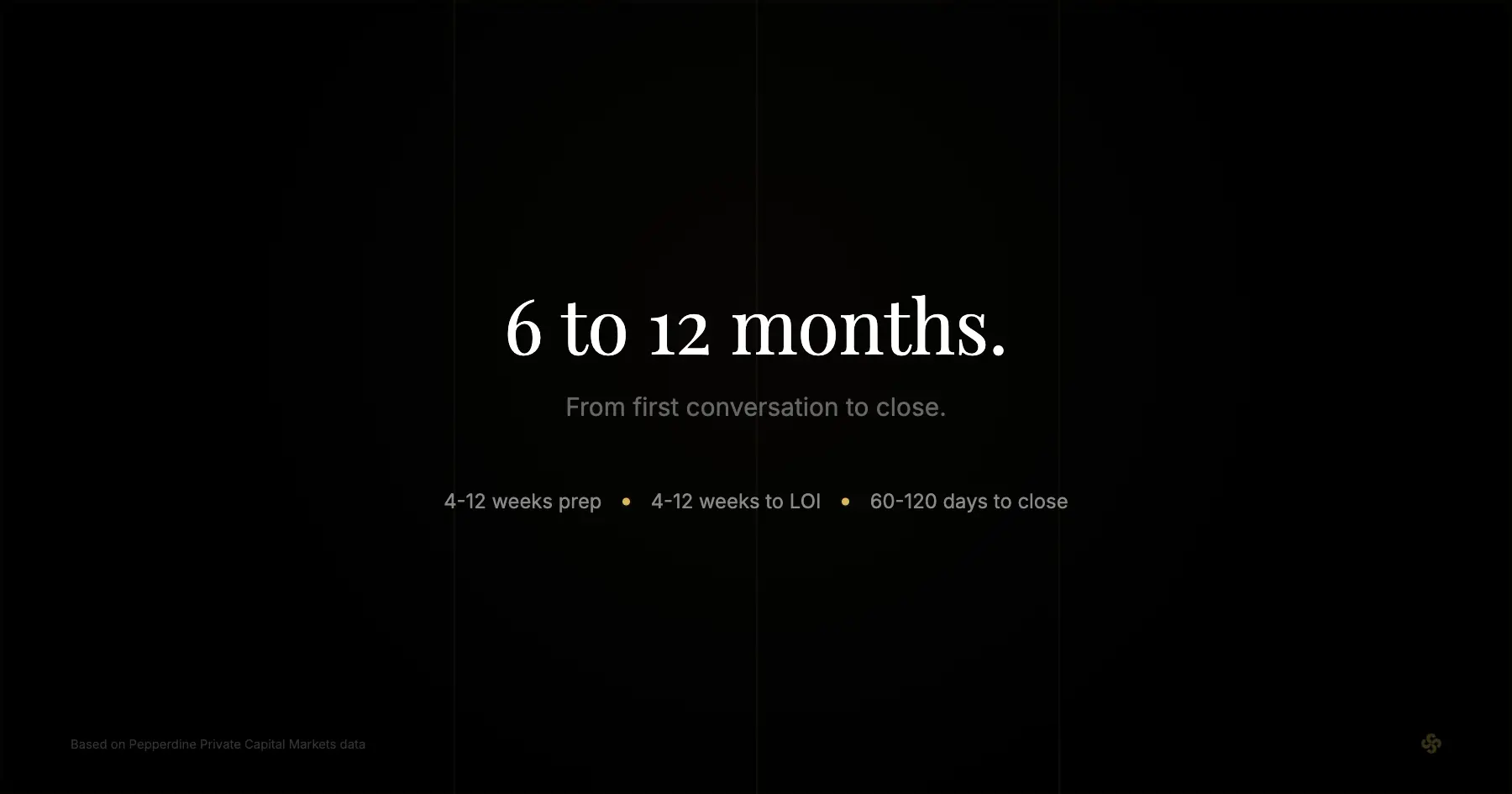
Based on data from the Pepperdine Private Capital Markets Project and IBBA transaction reporting, most mechanic shop sales take 6 to 12 months from first serious buyer conversation to close. The range is wide because preparation length varies enormously. An owner who spent two years cleaning up financials, documenting add-backs, and reducing their own operational footprint can move faster. An owner who starts that work after the first LOI conversation faces delays every step of the way.
Stage-by-stage timeline, based on data from the Pepperdine Private Capital Markets Project and International Business Brokers Association transaction reporting:
Stage | Typical duration | Key activities
Preparation | 4 to 12 weeks | Build monthly P&Ls, document add-backs, confirm lease status, prepare teaser
Outreach to signed LOI | 4 to 12 weeks (selective process); 8 to 16 weeks (broader market approach) | Buyer screening, NDA execution, CIM sharing, buyer conversations, LOI negotiation
Due diligence to close | 60 to 120 days | Document delivery, QoE, lender process, purchase agreement, closing mechanics
The preparation stage is the one owners most commonly underestimate. Not because it is complicated, but because it surfaces problems that need fixing before a buyer ever sees them. A lease with a problematic assignment clause, three months of messy QuickBooks entries, or an equipment line that has been running on a personal credit card; these are discovered during preparation if the owner does the work themselves, or during diligence if they do not. The cost of finding them during diligence is higher.
What to do now, prioritized by impact:
Financial documentation
Owner dependency reduction
Lease and facility
Pricing impact
[[cta-advisor]]
How do you sell an auto repair shop without employees finding out?
Run the process in stages and limit information to what each stage requires. Share only an anonymous teaser (no shop name, no address) with buyers before any NDA is signed. Share financials only after the NDA is executed and buyer seriousness is confirmed. Do not involve your attorney, accountant, or landlord until buyer conversations are underway and NDAs are in place. Staff are typically not informed until the deal is signed or very close to close. Telling employees too early creates distraction, turnover risk, and the possibility of information traveling to competitors.
What documents do buyers ask for when buying a mechanic shop?
The core request list: three to five years of federal tax returns, 36 months of monthly P&Ls, business bank statements, a documented add-back schedule with receipts, a current equipment list with financing status, lease and landlord consent letter, technician and staff roster with compensation, any fleet account agreements, Phase I Environmental Site Assessment, and business entity documents. Buyers may also request customer concentration data, warranty claim history, and supplier relationship documentation in later diligence stages.
How long does it take to sell a mechanic shop?
Between 6 and 12 months from first serious buyer conversation to close, based on data from the Pepperdine Private Capital Markets Project and IBBA transaction reporting. Preparation takes 4 to 12 weeks. Active outreach to a signed LOI takes another 4 to 12 weeks. Diligence and close typically runs 60 to 120 days after the LOI. Owners who complete financial preparation and address lease and environmental issues before going to market compress the back half significantly.
Do I have to stay on and work after I sell my mechanic shop?
It depends on the buyer. PE-backed platforms and independent sponsors typically require 3 to 12 months of active transition, sometimes more. Strategic operators often want 3 to 6 months. Search fund operators may want 12 to 24 months if they plan to run the business themselves. The length and structure of post-close involvement is negotiated in the LOI. If a clean exit is non-negotiable for you, that preference should be stated before a buyer invests time in diligence, not surfaced during purchase agreement negotiations.
What is my mechanic shop worth?
Value starts with normalized SDE or EBITDA. SourceCo's analysis of buyer conversations and deal data references general frameworks: smaller owner-operated shops under $5 million in revenue typically see 2.5 to 4.5 times normalized SDE; mid-size operations may see 3.5 to 5 times; multi-location platforms with professional management can exceed that range. No single published dataset covers mechanic-shop-specific multiples because private deal terms are rarely disclosed in full. What drives your shop toward the higher end of its range: documented management depth, diversified customer base with no single-account concentration, assignable lease with term remaining, clean monthly financials, and reduced owner dependency in customer and technician relationships.
What usually kills mechanic shop deals during due diligence?
Five predictable deal-killers: unsupported add-backs (the most common: every claimed add-back needs documentation that survives a QoE review), lease non-assignability (if the landlord can refuse or charge a transfer fee, some buyers walk), technician or service writer concentration (if one person drives 40% or more of revenue or carries key customer relationships, buyers price that through earnouts or price reductions), fleet account concentration (if one customer represents more than 20% of revenue, buyers model the risk of that relationship not transferring), and environmental surprises (Phase I surfaces prior-tenant contamination or underground storage tank history).
Do I really need to tell my staff before I close a deal?
No. Many owners wait until the deal is signed or very close to closing. Telling people too early risks distraction, rumors, and turnover. Share information in stages, only with people who need it to complete the deal. Your attorney, accountant, and landlord may need to be involved during diligence, but that does not require disclosing a sale to employees. The exact timing should depend on your buyer, your transition plan, and the advice of legal counsel familiar with your situation.
Can I sell the business and keep the real estate?
Yes, if the deal and property both make sense structured that way. Many owners sell the operating business and lease the building back to the buyer, either at market rate or at a negotiated rate. This can increase the purchase price for the business (the buyer gets a stable facility), generate ongoing rental income for the seller, and keep the real estate as a long-term asset. The structure and its tax implications should be reviewed with a tax advisor before finalizing any LOI.
Should I wait to sell until I fix every problem in the shop?
Fix the issues buyers will test hard and can verify quickly. Clean financials, documented add-backs, and reduced owner dependence in key customer or technician relationships have the highest impact on price and the highest probability of surviving diligence. Do not wait on issues that take years to resolve: a longer lease term, a second location, or a full management team built from scratch. Buyers will underwrite what they can verify in trailing 12 to 36 months. The improvements you make in the 90 days before a conversation start are difficult to underwrite. The systems you built in the preceding three years are what buyers are actually pricing.
What is the difference between an asset sale and a stock sale?
In an asset sale, the buyer purchases specific assets: equipment, goodwill, customer relationships, trade name. The seller retains the legal entity and its historical liabilities. Most mechanic shop transactions use this structure because buyers want to leave behind environmental, litigation, and lease liabilities that may be attached to the entity. In a stock sale, the buyer acquires the legal entity itself, inheriting all historical liabilities along with the assets. Sellers often prefer stock sales for capital gains tax treatment. Per IRS guidance on IRC §1060, both parties must use Form 8594 to report and agree on the purchase price allocation across asset categories. The right structure depends on your specific situation and requires tax and legal advice.
Selling a mechanic shop does not require broadcasting it. The owners who run the best processes start by building their documentation, identifying which buyer types fit their shop, and reaching out confidentially to a short list of qualified buyers. Not a listing. Not an auction. A controlled conversation with people who can actually close.
The preparation that takes 4 to 12 weeks before any buyer conversation is the same preparation that reduces retrades, shortens diligence, and produces cleaner closes. Most of it can be done without involving anyone outside the shop.
[[cta]]
Free Valuation Tool
.svg)
Before you contact a single buyer, get a first-pass estimate of what your shop could be worth. It takes two minutes and requires no outreach, no disclosure, and no commitment to a process.
Get Your Free Valuation
.svg)
Confidential & Free
.svg)
Before you contact a single buyer, get a first-pass estimate of what your shop could be worth. It takes two minutes and requires no outreach, no disclosure, and no commitment to a process.
Talk to an Owner Advisor
Active Buyers
.svg)
Match with pre-screened buyers from our network of 4,000+ active acquirers - see who is looking for a business like yours instantly.
See Who is Buying
.svg)
.svg)

.svg)
