Just Launched: The SourceCo Marketplace. Access vetted, off-market founder-led deals before anyone else.
Last deal added: 12 hours ago · Avg deal size: $8.2M · Median revenue: $4.9M
See Live Deals →

%20(1).png)
Private estimate. No cost to you.
See what the right buyer could pay
Enter your site. We'll show you real buyers acquiring in your space. No signup. Confidential.
Show Me →
Takes 30 seconds · No cost
Enter your site. We'll show you real buyers acquiring in your space. No signup. Confidential.
Show Me
Takes 30 seconds · No cost
A mechanic shop valuation calculator, including SourceCo's auto shop valuation calculator, estimates your shop's value from three inputs: a profit metric, a multiple, and the assumption that your reported numbers are defensible. Here is what to check before acting on the output.
[[step-process: 5 things to verify before acting on your calculator estimate]]
Which profit metric does the calculator use? | Most calculators apply a multiple to either SDE (Seller's Discretionary Earnings, the total economic benefit an owner extracts from the shop before taxes and non-cash items) or EBITDA (Earnings Before Interest, Taxes, Depreciation, and Amortization). Net income from your tax return is not the same number. If the calculator used net income as the base, the estimate is understated.
Are the add-backs documented? | Add-backs (costs that won't continue under new ownership, such as excess owner salary or a personal vehicle expensed through the business) increase the profit figure before the multiple is applied. Each add-back must be supported by a payroll record, receipt, or tax document. Undocumented add-backs are the first thing a buyer's accountant will challenge.
What multiple did the calculator apply? | Mechanic shop multiples are not published in a standardized dataset. Any range in a calculator reflects advisory heuristics, not confirmed market data. Treat the multiple as directional, not as a guaranteed buyer offer.
Does the multiple account for your buyer type? | An individual buyer stepping into the owner's role, a search fund, and a strategic multi-location platform will each price your shop differently. A calculator that applies a single range does not account for this variation.
Does the output show enterprise value or take-home proceeds? | Enterprise value (EV, the headline price a buyer pays before debt, adjustments, and costs) differs from your take-home proceeds. The proceeds calculation is explained below. Your actual take-home cash will be lower. The gap is explained below.
[[cta]]
Note: this guide focuses on mechanical auto repair shops specifically. Most general auto shop calculators blend collision and mechanical data. If your shop does collision or body work, some of these inputs, particularly the KPIs in the section below, will differ.
For most owner-operated mechanic shops, buyers start with SDE (Seller's Discretionary Earnings, the total benefit the owner extracts from the shop before taxes and non-cash items). For larger shops where a manager runs daily operations and the owner's role could be replaced without affecting revenue, buyers may use EBITDA (Earnings Before Interest, Taxes, Depreciation, and Amortization) instead.
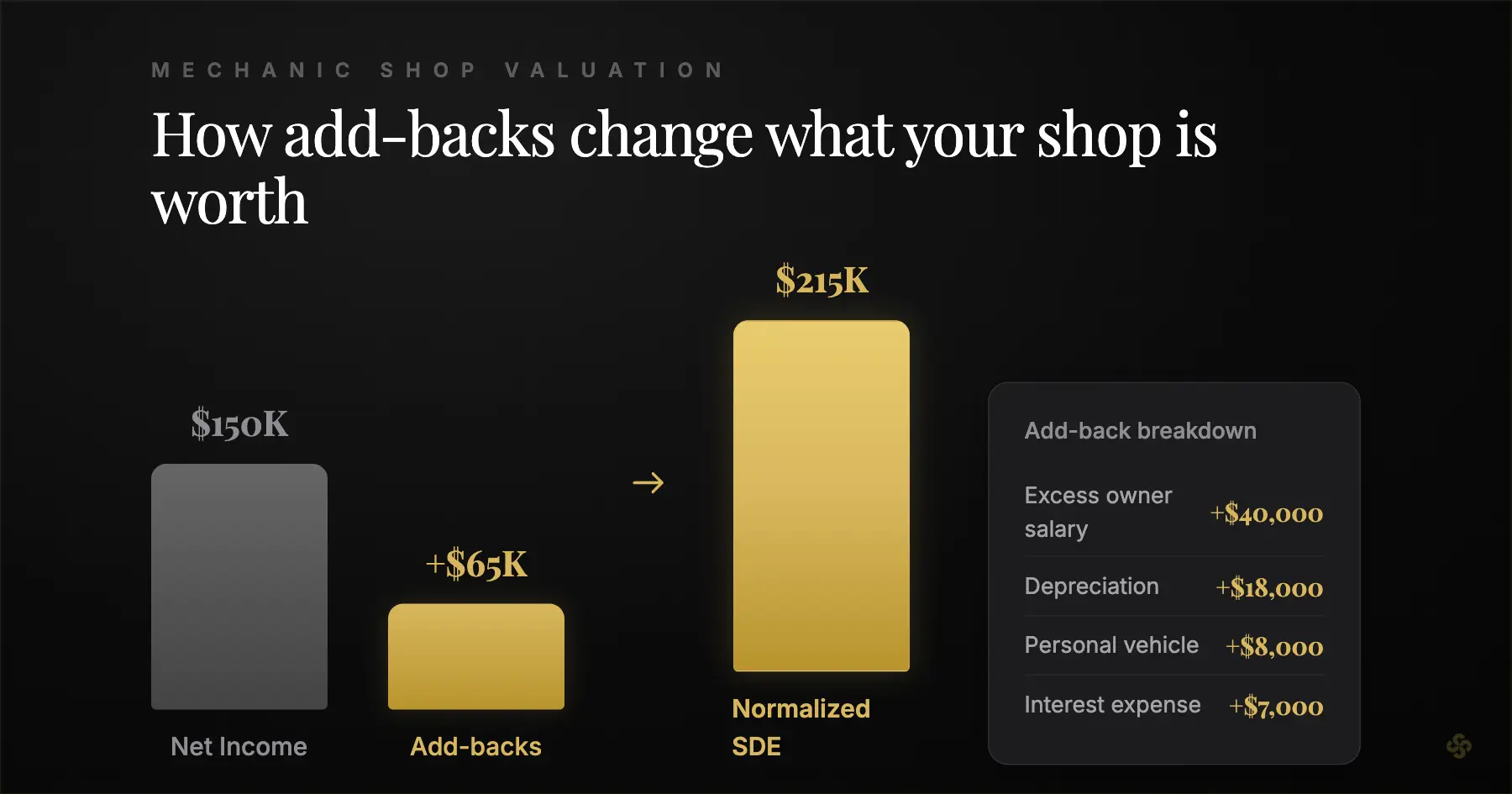
The difference is material. A shop reporting $150,000 in net income might show SDE of $215,000 once add-backs are applied: $40,000 in excess owner compensation above what a market-rate manager would cost, $18,000 in depreciation, and $7,000 in interest. Those items are all added back because a buyer does not inherit them.
Add-backs move the profit figure the multiple gets applied to. Two legitimate examples: owner salary above market rate, and personal expenses such as a vehicle or mobile phone run through the business. One example that is not an add-back: an owner salary at or below what a replacement manager would cost. Paying yourself $55,000 where a manager costs $55,000 leaves nothing to add back.
The result is normalized earnings (the cleaned-up profit figure a buyer believes will continue after closing). That is the number a serious buyer will scrutinize, not the net income line on your tax return. If your add-backs are not documented, the normalized earnings figure is not defensible. For a complete walk-through of how this calculation works, see our auto repair business valuation guide.
Buyers apply the multiple based on their read of how reliably the shop's earnings will continue. These are the factors they check, based on SourceCo's analysis of buyer conversations in automotive services transactions. Note that a published buyer checklist specific to mechanical repair shops does not exist in the sources available to us; these reflect patterns in adjacent automotive services evidence.
The calculator output is the enterprise value (EV, the headline price a buyer pays for the business before any deductions). What you actually receive at close is equity proceeds (the cash you keep after all deductions from enterprise value): enterprise value minus debt, adjustments, and costs.
Using the SDE of $215,000 from the example above, at a 2.5 times heuristic multiple (used here for illustration only, not as a published benchmark), enterprise value is approximately $537,000. The proceeds bridge shows what comes off before the check is written:
| | |
| Enterprise value (SDE $215,000 x 2.5x heuristic) | $537,000 |
| Minus: outstanding debt (loans, credit lines) | -$35,000 |
| Minus: working capital adjustments and deal costs | -$45,000 |
| Equity proceeds (estimated) | $457,000 |
The difference between $537,000 and $457,000 is $80,000, appearing at the closing statement, not at the LOI. Tax treatment of the proceeds depends on deal structure and whether it is an asset or stock sale. That calculation requires advice from your accountant.
For a mechanic shop, SourceCo's auto shop valuation calculator lets you run a private estimate before any conversation begins.
"I don't need anybody knowing what I'm exploring."
That is from an automotive services owner who wanted a real number before any external conversation began. Validating the estimate privately is a staged process: build the inputs before you share anything.
[[step-process: 5 documents to prepare before any private conversation]]
Last three years of tax returns and monthly P&Ls | These are the baseline. Buyers will request trailing 36 months of financials. Having them organized before any conversation prevents reactive disclosure.
A one-page add-back schedule with documentation | For each add-back, name the item, the annual amount, and attach the supporting document. Excess salary needs a market-rate comparison. Personal vehicle needs a mileage or billing record. Undocumented add-backs are cut by buyers.
Current lease with all amendments and renewal options | Assignability and remaining term affect price. Per IBBA diligence norms, lease review happens early in any serious conversation.
A basic staff map showing technician and service writer roles | List each person, their role, tenure, and whether their departure would materially affect revenue. This document goes to the buyer in a later stage, not the first.
A first-share list and a later-share list | Decide now what you will share upfront under NDA and what waits for a signed LOI. Financials and staff maps are not disclosed in an initial conversation. A summary of revenue range and service mix is. Staged sharing is how you stay in control of who knows what and when.
A confidential conversation with SourceCo costs nothing and commits you to nothing. SourceCo works on the buyer side, so there is no fee to the owner. The process is private and moves only as fast as you choose. When you are ready to think through the full sale process, how to sell a mechanic shop covers the complete sequence.
How do I value a mechanic shop using a calculator?
A mechanic shop valuation calculator multiplies a normalized profit metric (SDE or EBITDA) by a multiple to produce an enterprise value estimate. To use it accurately: know whether the calculator is applying the multiple to net income or normalized earnings, confirm that your add-backs are documented, and treat the output as a starting range rather than a fixed price. The estimate is most useful when you can verify the inputs independently and understand what deductions will reduce the headline number before you receive any cash at close.
Is the number from a mechanic shop valuation calculator accurate?
It is directionally useful but not precise. Calculators apply a heuristic multiple to an estimated profit figure. The actual multiple a buyer will pay depends on your specific shop's risk profile: technician depth, ARO trend, lease terms, and add-back defensibility. No published dataset isolates mechanic-shop-specific EBITDA multiples, so any range in a calculator reflects advisory experience rather than confirmed transaction data. Use the estimate to understand the order of magnitude, then validate the inputs with a buyer-qualified analysis before sharing your financials with anyone.
What inputs make the biggest difference in a mechanic shop valuation estimate?
Three inputs move the estimate most: the earnings metric used (SDE or EBITDA), the add-backs applied to get there, and the multiple selected. The earnings metric and add-backs determine the base figure the multiple is applied to. A $40,000 add-back at a 3x multiple adds $120,000 to the headline value. The multiple then varies based on shop size, management depth, technician stability, and buyer type. Getting the earnings metric and add-backs right matters more than debating the multiple range.
Why is the calculator value different from what I'll take home after a sale?
The calculator outputs enterprise value: the headline price before any deductions. Take-home proceeds are enterprise value minus outstanding debt, minus working capital adjustments and deal costs, minus taxes. In a worked example with SDE of $215,000 at a 2.5 times heuristic multiple, enterprise value is approximately $537,000. After debt of $35,000 and adjustments of $45,000, estimated equity proceeds are $457,000. That $80,000 gap is not visible in the calculator output and appears at the closing statement, not when the multiple is agreed.
What will a buyer ask for to validate my valuation estimate?
Three years of federal tax returns and monthly P&Ls, a one-page add-back schedule with documentation for each item, and confirmation of lease assignability and remaining term. Beyond financials, buyers will ask about technician tenure and key-person concentration, fleet account share of revenue, and warranty or comeback rates. These are not documents the seller provides upfront: they go to a qualified buyer under NDA after an initial conversation establishes serious mutual interest.
Should my mechanic shop be valued on SDE or EBITDA?
For owner-operated shops where the owner's compensation is the primary economic return, SDE is the appropriate starting metric. For shops with a manager running daily operations independently, buyers may use EBITDA. The distinction matters because SDE adds back excess owner compensation (above what a market-rate manager would cost), while EBITDA does not. If you pay yourself at or below market rate, the SDE and EBITDA figures will be close. If you pay yourself significantly above market, SDE will be higher and more favourable.
How do add-backs affect the calculator output?
Add-backs increase the normalized profit figure before the multiple is applied. Each dollar of a legitimate, documented add-back increases the estimate by the full multiple. At a 3x multiple, a $30,000 add-back adds $90,000 to the headline value. The risk is that buyers challenge undocumented add-backs during diligence and either reduce the profit figure or adjust the purchase price. Add-backs that survive scrutiny are those with a clear business rationale and a supporting document.
How do I check the estimate without losing confidentiality?
Start with your own inputs: calculate SDE from your tax return, document each add-back, and map your key technician dependencies. That work is entirely private. When you are ready to test against a buyer-quality view, SourceCo can provide a confidential estimate based on comparable buyer conversations in automotive services, with no buyer outreach, no listing, and no obligation. The owner controls the pace and decides what to share and when.
A calculator gives you a starting point. The number that matters is what a qualified buyer, looking at your actual documents, is prepared to pay on terms that hold from offer to close.
Validating that privately costs nothing and changes nothing about the shop. The five-step preparation above is the right first move.
Related: Auto repair business valuation · How to sell a mechanic shop · Sell my auto repair shop · Auto body shop valuation EBITDA multiple · Tire shop valuation
Free Valuation Tool
.svg)
Before you contact a single buyer, get a first-pass estimate of what your shop could be worth. It takes two minutes and requires no outreach, no disclosure, and no commitment to a process.
Get Your Free Valuation
.svg)
Confidential & Free
.svg)
Before you contact a single buyer, get a first-pass estimate of what your shop could be worth. It takes two minutes and requires no outreach, no disclosure, and no commitment to a process.
Talk to an Owner Advisor
Active Buyers
.svg)
Match with pre-screened buyers from our network of 4,000+ active acquirers - see who is looking for a business like yours instantly.
See Who is Buying
.svg)
.svg)

.svg)
