Just Launched: The SourceCo Marketplace. Access vetted, off-market founder-led deals before anyone else.
Last deal added: 12 hours ago · Avg deal size: $8.2M · Median revenue: $4.9M
See Live Deals →

%20(1).png)
Confidential from first call. No listing. No commission from you.
Start a confidential conversation
Enter your site. We'll show you real buyers acquiring in your space. No signup. Confidential.
Show Me →
Takes 30 seconds · No cost
Enter your site. We'll show you real buyers acquiring in your space. No signup. Confidential.
Show Me
Takes 30 seconds · No cost
"The only way we would be interested is if it was quick and if it was painless... because it's an emotional roller coaster and it's caused us a lot of stress at home, at work."
An owner who had been through a prior process said that. Not opposed to selling. Opposed to going through it again.
The risk is not one thing: word gets out, the wrong buyer takes months and then declines, and the offer produces $300,000 less at close than the headline said.
You can sell your auto repair shop without any of that. Screen buyers before they see your financials: for financial capacity, strategic fit, and closing track record. Require a signed NDA (Non-Disclosure Agreement, a contract preventing buyers from sharing your information) before anything identifying is shared. Evaluate every offer on cash at close, not headline price. That sequence protects you whether your concern is who finds out, who wastes your time, or what you actually take home.
Yes. The shop name, address, and financial detail do not leave your control until a buyer has earned access to them. For a well-prepared mechanical shop, the full process from preparation to close typically takes 6 to 12 months, per IBBA guidance on confidential small business sales.
[[step-process: 5 stages of a controlled auto repair shop sale]]
Anonymous teaser | A one to two page summary: service mix, revenue range, general geography. No shop name. No address. No employees named. Shared with pre-screened buyers only to test interest.
NDA (Non-Disclosure Agreement) | A legally binding contract preventing the buyer from sharing, using, or disclosing your information. Required before any identifying detail is shared. Non-negotiable.
CIM (Confidential Information Memorandum) | A detailed buyer packet with financials, operations, customer mix, and facility details. Shared only after the NDA is signed and initial buyer interest is confirmed.
LOI (Letter of Intent, the document that sets price and key terms before formal diligence begins) | Signed after buyer and owner align on headline terms. Starts the exclusivity window.
Due diligence and close | The buyer verifies everything the price was based on. Purchase agreement is negotiated. Close follows.
In a mechanical shop, the specific leak risks are different from other businesses. The people most likely to hear something before you are ready: technicians who talk to reps at other shops; service writers who notice new faces or unusual questions; fleet account contacts who call regularly; parts and tool vendors who visit every week. Controlling information means controlling the sequence, not just the words.
[[cta-advisor]]
The buyer who pays the most is not always the buyer who makes the sale easiest or the terms most favorable. Different buyer types want different things from the owner after close, structure their offers differently, and screen for different qualities in the shop. Some structures include an earnout (proceeds contingent on post-close performance, paid over time if targets are met) or a seller note (a loan from you to the buyer, repaid with interest).
Buyer type | What they want from the shop | What they typically ask for | Post-close expectations
PE platform | Management depth, repeatable EBITDA (Earnings Before Interest, Taxes, Depreciation, and Amortization), documented systems, scalable operations | Earnout tied to technician or revenue retention, 60-90 day exclusivity | 3 to 12 months active involvement; defined operating role
Independent sponsor | Strong earnings, owner dependence is tolerable with a clear transition plan | Seller note (a loan from you to the buyer, repaid with interest over 3-7 years) on part of the price | 6 to 24 months; new operator plans to take over the role
Strategic operator | Local market fit, customer and technician relationship quality | Seller note common; simpler deal structure overall | 3 to 6 months; often integrates into existing operations
Search fund / individual buyer | Clean SDE (Seller's Discretionary Earnings, total earnings including owner compensation), low single-person concentration, defined transition | Earnout or seller note; longer transition expectations | 12 to 24 months; buyer takes over actively
"This is my lifelong baby. I don't want to see it go to crap."
That is from an owner thinking through buyer fit. The right buyer for this owner was not the one who offered the most. It was the one who would run the shop the way it deserved to be run. That concern is not soft. It is why the buyer type table above matters beyond the column headed "what they typically ask for."
Based on SourceCo's analysis of buyer conversations in automotive services transactions, management depth and clean financials move the multiple within a size band regardless of buyer type. An owner-dependent shop can still find the right buyer, typically an operator-led buyer who plans to step in directly, not a platform that needs a management team already in place.
Real estate and lease terms also change buyer interest. If you own the building, the transaction may separate into two components. If you lease, remaining term and assignability are evaluated before any offer is finalized.
[[cta-match]]
Serious screening happens before a buyer receives meaningful detail, not after. The goal is to spend your time only with buyers who can actually close and whose investment logic fits your shop.
Before any buyer sees financials or gets a shop tour, SourceCo confirms: financial capacity to close (proof of funds or lender commitment), operating experience in automotive services or adjacent businesses, a credible strategic or operational rationale for this type of shop, direct decision-maker access (not a coordinator or scout), and a realistic timeline.
A buyer who has not signed an NDA has no obligation to protect your information and nothing to lose if word gets out. Screening before sharing is how confidentiality is maintained, not just how time is protected.
Shop tours come last, not first. The owner's time is limited; a serious buyer understands that access escalates with commitment.
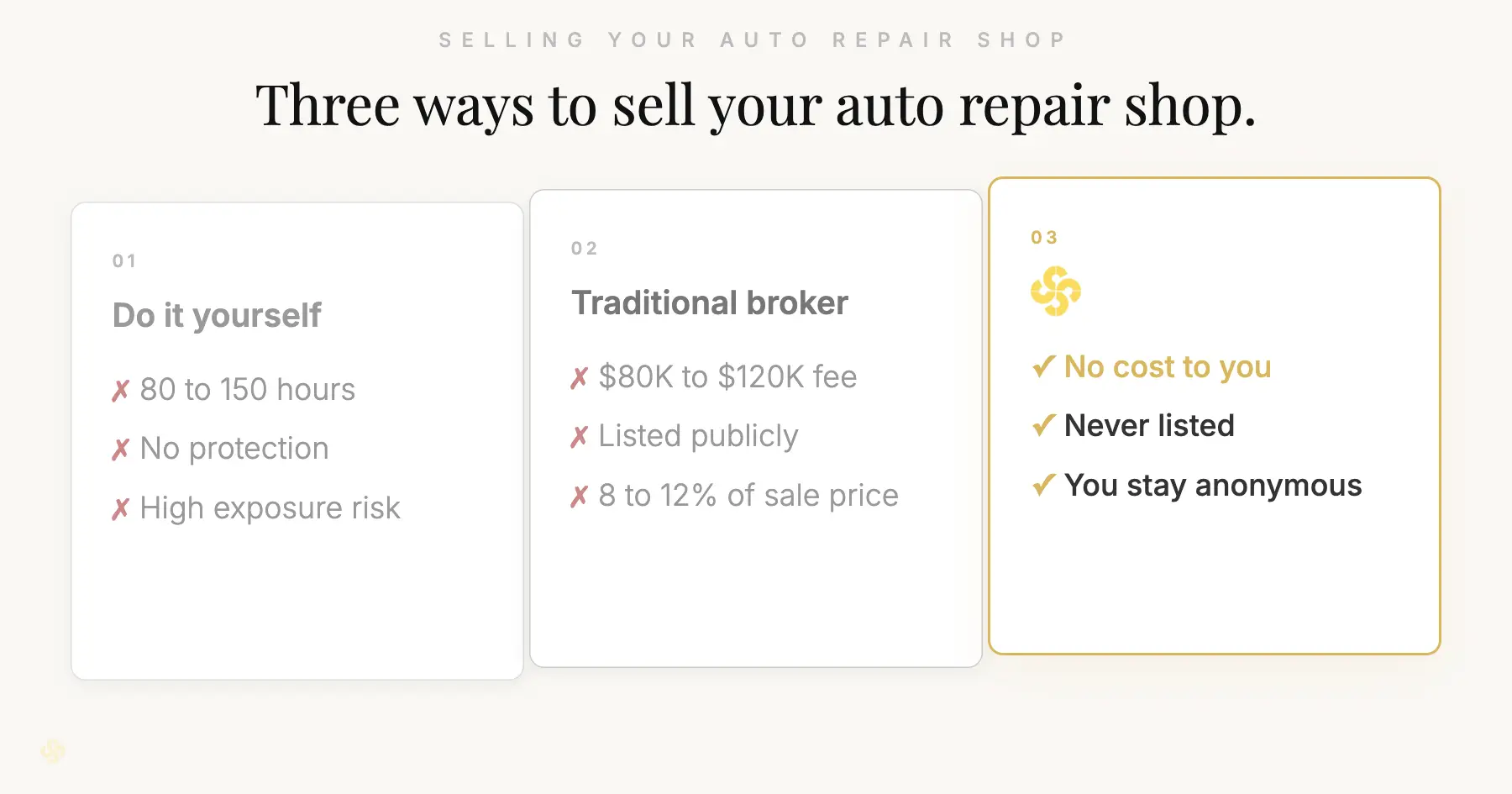
There are three paths to finding a buyer for an auto repair shop. They are not equivalent.
Do it yourself
Running a confidential DIY sale requires approximately 80 to 150 hours over 3 to 6 months, based on SourceCo's analysis of owner-managed sale processes. You build the teaser, identify buyers, screen them without a database of transaction history, manage document requests while your shop continues to operate, and review LOI terms for the first time. At every stage, the buyer has done this many times. You are doing it once.
The confidentiality exposure is meaningful. DIY outreach typically reaches people in your network or local market: operators and contacts who may know your technicians, suppliers, or competitors. One conversation in the wrong direction ends confidentiality before you have a deal.
Traditional broker-led sale
Business broker commissions for small business sales typically run 8 to 12% of the sale price, per IBBA broker fee norms. On a $1 million transaction, that is $80,000 to $120,000 off your proceeds before anything else is subtracted.
The confidentiality exposure is structural. A broker-listed business appears in listing databases visible to anyone: employees, competitors, customers, suppliers. A mechanical shop listed in a regional market is not confidential by default. The broker's incentive is to close a deal, not to find the right buyer. They earn the same fee whether the buyer is a strong cultural fit or the first serious offer that meets the headline price.
SourceCo
Two inputs: your numbers, and a conversation about what you are looking for.
SourceCo matches your shop to buyers in our network whose investment thesis, deal structure preferences, and post-close philosophy actually fit what you described. The shop is never listed. Buyers are contacted anonymously. Identity is only shared after buyer interest is confirmed and an NDA is in place. There is no commission from the seller. SourceCo works on the buyer side.
The honest limitation: SourceCo's network is finite. If no buyer currently in the network is the right fit, the timeline may extend while the right match is identified.
How the three paths compare:
| Do it yourself | Traditional broker | SourceCo
Cost to owner | 80-150 hours of your time, based on SourceCo's analysis of owner-managed processes | 8-12% of sale price (per IBBA fee norms); $80K-$120K on a $1M deal | No cost: SourceCo works on the buyer side
Confidentiality exposure | High: outreach reaches people in your market who know your staff and competitors | High: shop listed in databases visible to employees, competitors, and customers | Controlled: anonymous outreach only, identity never shared without signed NDA
Buyer quality and fit | Limited to your personal network; no screening infrastructure | Volume-optimized; fit is secondary to closing | Pre-screened against your shop profile and stated preferences before any conversation
Cultural fit matching | You describe what you want; buyers hear what they want | Broker knows the numbers; typically does not carry your priorities into buyer conversations | Based on real buyer conversations SourceCo has had about culture, transition philosophy, and post-close expectations
Time from you | 80-150 hours alongside running the shop | Less than DIY, but not zero | One conversation and your numbers
Information advantage | Buyers negotiate these transactions routinely; you are doing it once. Every LOI term and deal structure the buyer proposes is familiar to them and new to you | Broker guides the process, but you still depend on their interpretation of buyer intent and term risk | SourceCo's buyer network and transaction history inform the match before any conversation starts, so your opening position reflects real buyer behavior, not first-time assumptions
Commission impact on proceeds | None from this path alone (but unreviewed LOI terms have real dollar cost) | $80K-$120K on a $1M deal before anything else comes off | None: that money stays in your waterfall entirely
"time kills deals"
That is from an owner we helped who had been through a slow process that consumed months before collapsing. The right buyer matched quickly, with financing in place and a clear rationale for your shop type, closes faster and with less disruption than the wrong buyer who takes three months of your time and then retraded.
[[cta-match]]
Serious buyers need clean financials plus operating reports showing stable shop performance. An offer built on undocumented numbers is an offer that will be renegotiated during diligence.
[[definition-list: Documents buyers need to take a mechanical auto repair shop seriously]]
Financial records | Three to five years of federal tax returns; monthly P&L statements for at least 36 months; business bank statements for 24 to 36 months; an add-backs (costs that won't continue under new ownership) schedule with documentation for each item: payroll records, receipts, invoices.
Operational records | Equipment list with ownership status; technician and service writer roster with certifications, tenure, and compensation; customer list with revenue by account (aggregated, not individually named until late diligence); fleet account contracts; warranty claim data and comeback rate records for 12 to 24 months.
Lease and facility | Current lease with all amendments; landlord consent confirmation for assignment; proof of renewal options and remaining term. If real estate is owned: deed, title, most recent appraisal.
Environmental | Phase I Environmental Site Assessment per EPA ASTM E1527-21 standards (required by virtually all institutional buyers and SBA lenders for facilities with fluid storage, underground tanks, or hazardous materials history); fluid disposal manifests; hazardous waste compliance documentation.
The operational KPIs that buyers specifically examine in a mechanical shop: ARO (average repair order, the average revenue per vehicle visit), effective labor rate relative to posted rate, bay utilization, technician depth and concentration, fleet versus retail revenue mix, and warranty or comeback rate. These tell buyers whether the shop's earnings are repeatable or dependent on conditions that change when the owner leaves.
Organizing these documents before any buyer conversation is where preparation pays off.
[[cta-advisor]]
Price is one line in an offer. The lines beneath it determine what you actually receive.
"A slow five is better than a fast 10."
That is from an owner who had thought carefully about what they actually wanted from a sale. A higher headline with contingencies, an extended transition, and holdbacks spread over two years may produce less cash on day one than a lower headline with clean terms. Understanding that difference before you compare offers is the difference between evaluating offers correctly and reacting to the wrong number.
An offer's headline price is the enterprise value (the total business price before any deductions). What lands in your account is what remains after: outstanding debt and equipment loans, any working capital shortfall (the gap between the current assets the buyer requires and the actual balance at close), and transaction costs.
Earnout (proceeds contingent on post-close performance targets, paid over time if defined targets are met) and escrow (proceeds withheld after close against potential claims, typically 5 to 10% released after 12 to 18 months) reduce the check further still.
Both offers arrive described as $1,200,000. The earnout and holdback lines appear in the buyer's attorney's first draft of the purchase agreement, after the LOI is signed and exclusivity has started.
Here is what the same $1,200,000 headline produces under two different structures:
| Offer A (clean terms) | Offer B (conditional terms)
Enterprise value | $1,200,000 | $1,200,000
Transaction costs | -$40,000 | -$40,000
Earnout (15% tied to technician retention, 12 months) | None | -$180,000
Escrow/holdback (10%, 18-month release) | None | -$120,000
Cash at close | $1,160,000 | $860,000
That is a $300,000 gap from the same headline price. If the earnout and holdback both come in full, Offer B's total reaches $1,160,000, the same as Offer A at close. But $300,000 of that arrives over 18 months, contingent on hitting targets the buyer sets. Required post-close work commitments of 18 months versus a defined 6-month transition represent additional value that does not appear in any column of the offer table.
Signing the LOI (Letter of Intent, the document that sets price and key terms before formal diligence begins) is when the process becomes consequential. From that day, the seller is in exclusivity: no other buyers, no parallel conversations, while the buyer verifies everything the price was based on.
Diligence typically runs 60 to 90 days. The stages after the LOI:
The timeline varies and should not be promised. In SourceCo's experience reviewing these processes, buyers rarely surface problems at day five of diligence. They surface them at day 55, when exclusivity is nearly exhausted and the cost of walking away is highest for the owner.
What usually kills mechanic shop deals in this window:
"So holding $100,000 back for a year was, to me... not really acceptable."
That is from an owner who had built a clean shop with documented systems, low comeback rates, and stable staff, and still faced a holdback that felt disproportionate to the risk the buyer was actually taking. Knowing the escrow norms before you evaluate any offer lets you negotiate from clarity, not surprise.
[[cta-advisor]]
How long will I need to stay after closing?
It depends on the buyer and the deal terms. PE-backed platforms and independent sponsors typically require 3 to 12 months of active involvement. Strategic operators often want 3 to 6 months. Search fund operators may want 12 to 24 months if they plan to run the shop themselves. The length and structure of post-close involvement is negotiated in the LOI. If a clean exit is non-negotiable for you, state that preference before any buyer invests time in diligence, not during purchase agreement negotiations after exclusivity has run.
Can I sell my auto repair shop without listing it publicly?
Yes. A public listing is not required and for most mechanical shop owners is not advisable. The confidential path: prepare a one to two page anonymous summary with no shop name or address, share it with a short list of pre-screened buyers under NDA, and escalate to full financials only after buyer interest is confirmed and identity is protected. No listing means no exposure to employees, competitors, customers, or suppliers before you have decided anything.
How do you keep a shop sale confidential from employees and customers?
Run the process in stages and limit information to what each stage requires. Use an anonymous teaser before any NDA. Involve your attorney from the start for your own NDA review, but do not have them conduct outreach or signal the sale publicly. Share financials only after the NDA is executed. Do not alert your landlord until late diligence. Staff are typically not informed until the deal is signed. Telling employees too early creates distraction, turnover risk, and information reaching competitors through vendor or customer networks.
How do you screen buyers so I don't waste time?
Screening happens before any buyer receives meaningful detail. The checks: financial capacity to close (proof of funds or lender commitment), operating experience in automotive services, a credible rationale for this type of shop, direct decision-maker access, and a realistic timeline. Shop tours come late, not early. A buyer who cannot answer basic qualification questions before seeing your financials is not a buyer who will close.
What documents will I need before buyers take me seriously?
The core request: three to five years of tax returns, 36 months of monthly P&Ls, business bank statements, a documented add-back schedule with receipts and payroll records, a current equipment list with financing status, lease with all amendments and landlord consent confirmation, technician and staff roster with compensation, fleet account agreements, Phase I Environmental Site Assessment, and business entity documents. Buyers may also request customer concentration data, warranty claim history, and ARO and effective labor rate data in later diligence stages.
What happens after an LOI is signed when selling an auto repair shop?
From the day the LOI is signed, you are in exclusivity: no other buyers, no parallel conversations, for 60 to 90 days while the buyer verifies everything the price was based on. The buyer's team reviews financials, operations, lease, and environmental records. A quality of earnings review tests every add-back. If financing is involved, lender underwriting runs in parallel. After diligence, parties negotiate the purchase agreement. Close follows. Timeline varies by preparation quality on the seller's side and financing complexity on the buyer's.
What can kill a deal late in the process and how do you prevent it?
Five predictable deal killers: unsupported add-backs (the most common: every claimed add-back needs documentation that survives a quality of earnings review), lease non-assignability (confirm assignability before LOI, not during diligence), technician concentration (if one person drives 40% or more of production, buyers price that risk through deal structure), environmental surprises (commission your own Phase I before going to market so you control the timeline), and earnout misalignment (if the buyer's required transition and your clean-exit preference are incompatible, surface that before exclusivity begins, not after).
Why can two offers at the same price lead to very different take-home proceeds?
Because price is the enterprise value (the headline before any deductions). What you receive is enterprise value minus debt, minus any working capital shortfall at close, minus transaction costs, minus any earnout withheld pending post-close targets, minus any escrow held against potential claims. A $1,200,000 headline with a 15% earnout and a 10% holdback produces $860,000 at close. The same headline with clean terms produces $1,160,000. Map the full bridge before reacting to any headline number.
Selling your shop the right way does not require broadcasting it. It requires a short list of qualified buyers, a process that protects your staff until you decide the timing is right, and terms that reflect what you actually need from the exit, not just the headline number.
The preparation that protects you is the same preparation that makes buyers take your shop seriously: documented add-backs, clean financials, and a lease that transfers cleanly.
[[cta-advisor]]
Free Valuation Tool
.svg)
Before you contact a single buyer, get a first-pass estimate of what your shop could be worth. It takes two minutes and requires no outreach, no disclosure, and no commitment to a process.
Get Your Free Valuation
.svg)
Confidential & Free
.svg)
Before you contact a single buyer, get a first-pass estimate of what your shop could be worth. It takes two minutes and requires no outreach, no disclosure, and no commitment to a process.
Talk to an Owner Advisor
Active Buyers
.svg)
Match with pre-screened buyers from our network of 4,000+ active acquirers - see who is looking for a business like yours instantly.
See Who is Buying
.svg)
.svg)

.svg)
